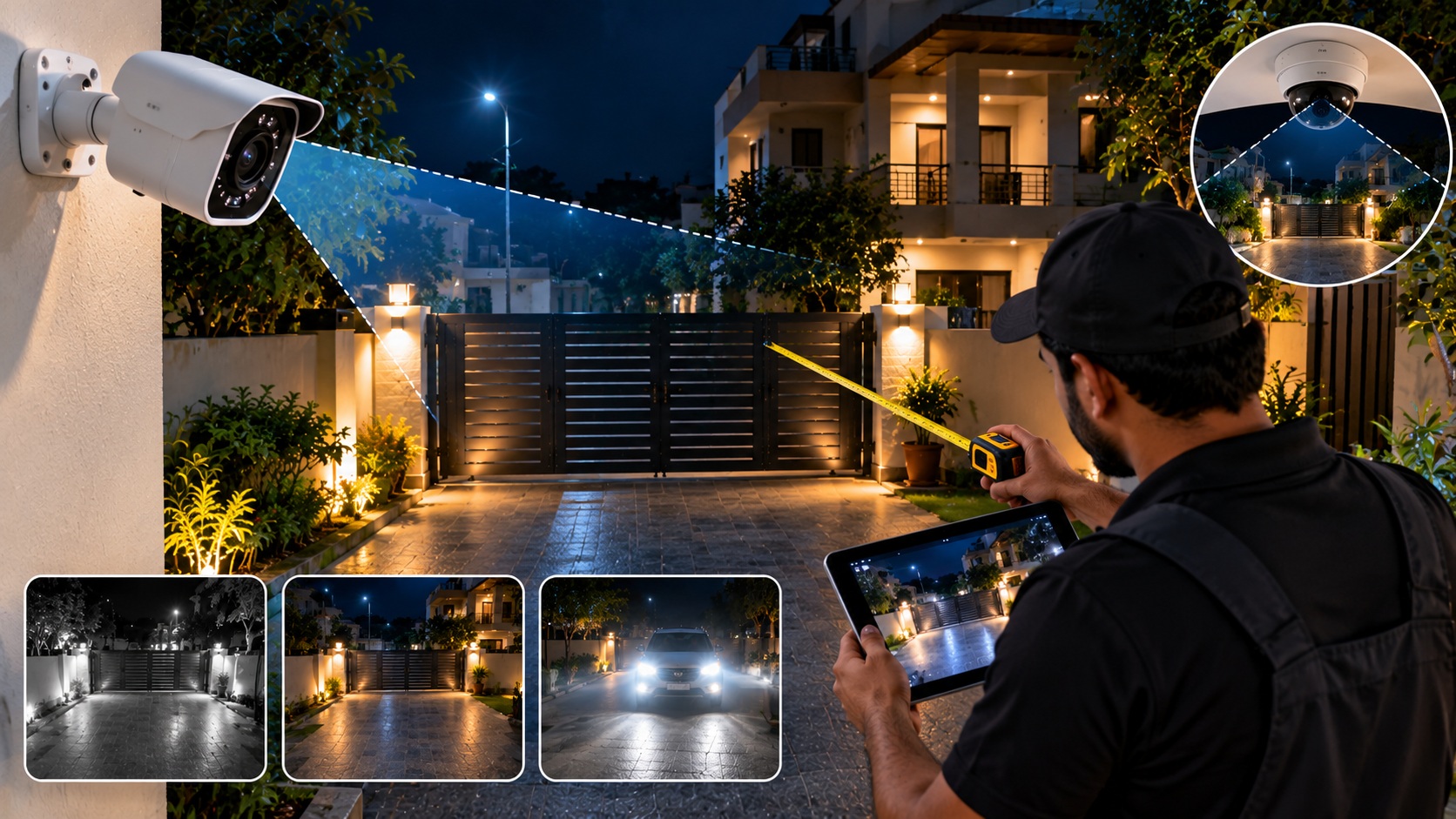
You install a CCTV camera outside your house.
The box says:
“30M IR Night Vision.”
You feel safe.
Then, one night, something happens at the gate. You open the recording—and instead of a clear face, you see a dark figure, a glowing white patch, and two headlights.
So what went wrong?
The camera may not actually be “bad.”
The problem is that night-vision range and identification range are two completely different things.
This is one of the most misunderstood parts of buying CCTV cameras.
A camera can illuminate an area 30 metres away and still fail to give you enough detail to identify the person standing there.
Here’s what you should actually look at before buying a night-vision CCTV camera.
First: What Does “30-Metre Night Vision” Actually Mean?
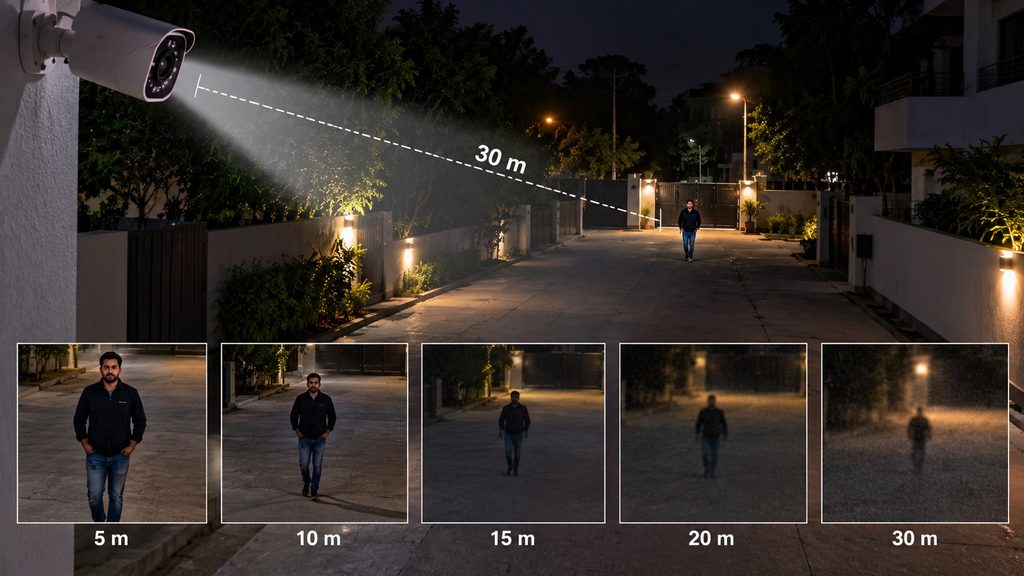
When a manufacturer advertises a camera with 30m IR night vision, it generally refers to the distance over which the camera’s infrared illumination is designed to provide usable visibility.
It does not automatically mean:
“You can clearly identify a person’s face 30 metres away.”
That distinction matters.
Imagine a person standing 25–30 metres from the camera.
You may be able to see:
- A person is present
- Their general movement
- Their approximate clothing
- The direction they’re walking
But you may not be able to reliably determine:
- Facial features
- Small objects in their hands
- Vehicle number plates
- Fine details on clothing
- Identity from facial appearance
At night, the camera has much less light to work with, and image noise, exposure and distance all become more important.
The 5 Things That Actually Determine Night-Time CCTV Quality
Don’t choose a night camera by IR distance alone.
Look at these five factors.
1. The Image Sensor
The sensor is one of the most important components in low-light performance.
Two cameras can both be advertised as:
4MP
but produce noticeably different night images.
Why?
Because resolution is only one part of image quality.
Sensor size, sensitivity, lens aperture and image processing also matter.
A larger or more light-sensitive sensor can collect more useful information in difficult lighting conditions.
This is why simply moving from 2MP to 4MP or 5MP doesn’t automatically solve every night-vision problem.
2. IR Illumination
Traditional CCTV cameras use infrared LEDs to illuminate dark areas.
Humans can’t normally see this infrared light, but the camera sensor can.
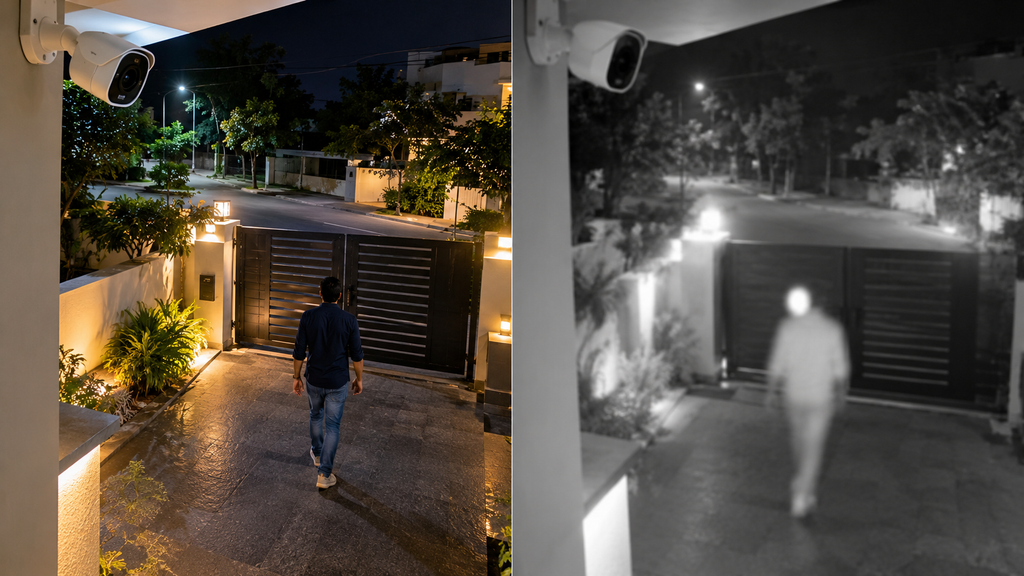
The camera then switches into a black-and-white night mode.
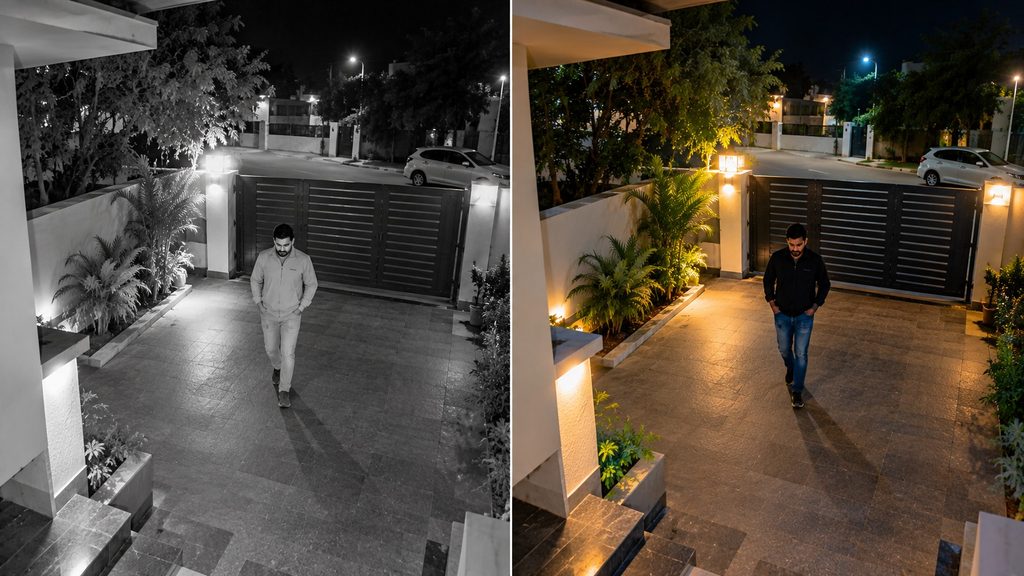
This is why many conventional CCTV systems show excellent black-and-white footage at night.
The advantage?
It can work even when the area is extremely dark.
The limitation?
You lose normal colour information.
So instead of:
“The person is wearing a red shirt.”
you may only see:
“The person is wearing a light-coloured shirt.”
That can matter during an investigation.
3. Colour Night Vision Isn’t Magic
This is where CCTV marketing becomes confusing.
You’ll see terms such as:
- Full-colour night vision
- Colour night vision
- Starlight
- Full-colour technology
- AI colour night vision
But these technologies don’t all work the same way.
There are broadly two common approaches.
Low-light colour imaging
A highly sensitive sensor uses available ambient light—such as streetlights, porch lights or nearby building lights—to maintain colour footage.
This can work extremely well in low-light environments.
But there’s an important catch:
Low light is not the same thing as zero light.
If the scene is completely dark, the camera needs another source of illumination.
Spotlight-assisted colour
Some cameras turn on a visible white light when motion is detected.
Now the camera has enough illumination to capture colour.
That’s useful because you might see:
- Vehicle colour
- Clothing colour
- More natural-looking faces
- Objects that would otherwise appear monochrome
But the spotlight is also visible.
That may be useful as a deterrent—or annoying if the camera is installed near bedrooms, neighbours or a road.
4. Lens and Field of View
Here’s another mistake:
People often buy a wide-angle camera and assume wider is always better.
It isn’t.
Suppose you have a gate 25 metres away.
A very wide lens may cover the entire entrance.
Sounds good.
But the same number of pixels are now spread across a much wider scene.
The person at the gate occupies fewer pixels.
A narrower lens may show less of the surrounding area but put more pixels on the person you’re actually interested in.
Think about your objective.
If your goal is:
“I want to know whether someone entered my property.”
A wide view may be excellent.
If your goal is:
“I want to identify a person’s face at the gate.”
Camera placement and lens selection become much more important.
5. Lighting at the Installation Point
Before buying a camera, stand where the camera will be installed at night.
Look around.
Is there:
- A streetlight?
- Porch light?
- Garage light?
- Security light?
- Light from neighbouring buildings?
- Vehicle headlights?
Even a small amount of useful ambient light can dramatically change the type of camera you should consider.
For example:
Gate with street lighting
A good low-light colour camera may be an excellent choice.
Completely dark backyard
IR night vision may be more practical.
Parking area
A camera with strong IR plus good exposure handling may be preferable.
Shop entrance
Colour night vision can be useful because clothing and vehicle colour may become important.
The Headlight Problem Nobody Talks About
Here’s a classic CCTV night-time failure.
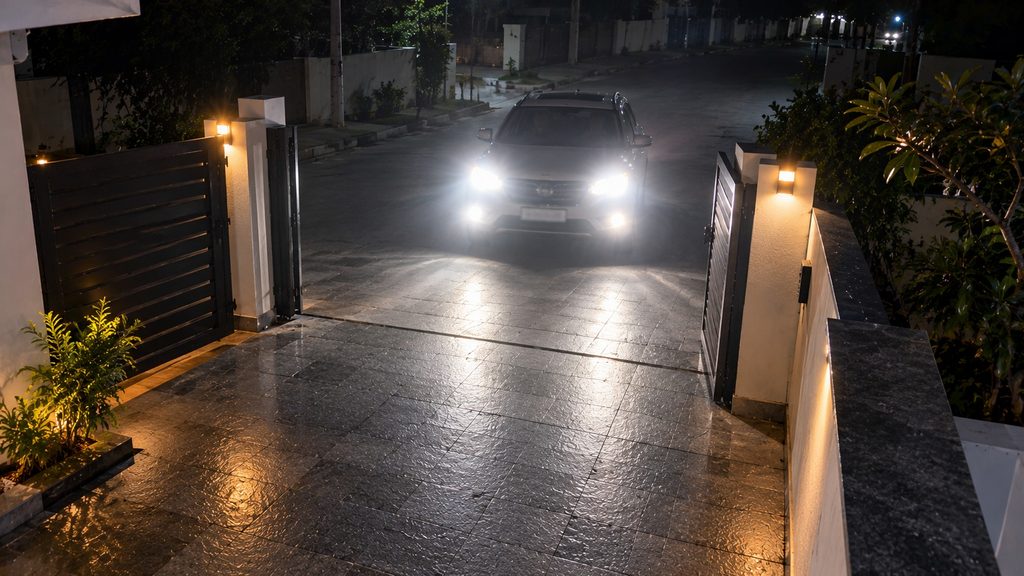
A car approaches your camera.
Its headlights point directly toward the lens.
Suddenly the recording looks terrible.
The person beside the vehicle disappears into darkness while the headlights become giant white blobs.
This is an exposure and dynamic-range problem, not simply a resolution problem.
That’s why features such as HDR/WDR can matter in difficult scenes.
Why IR Sometimes Creates a White Face
You may have seen this before.
A person walks close to the camera.
Their face becomes almost completely white.
This is often caused by the IR illumination reflecting strongly from a nearby subject.
Good cameras may use technologies such as Smart IR to adjust illumination and reduce overexposure.
This is particularly important for:
- Doorways
- Narrow corridors
- Gates
- Small parking areas
- Camera positions where people walk close to the lens
So How Far Can a CCTV Camera Actually See at Night?
There isn’t one universal answer.
A manufacturer may specify an IR range such as 20m, 30m, 40m or more.
But the useful distance depends on what you want to accomplish.
Think of night-time coverage in three levels:
Level 1 — Detection
“Something is there.”
You can see movement or a person entering the area.
Level 2 — Observation
“I can understand what is happening.”
You can see movement, clothing and general activity.
Level 3 — Identification
“I have enough detail to identify the person/object.”
This is much harder.
And this is the level people often assume their “30m night vision” specification guarantees.
It doesn’t.
A Better Way to Choose Your CCTV Camera
Instead of asking the installer:
“Kitne meter ki night vision hai?”
ask these questions:
1. How far is the target?
10 metres?
20 metres?
30 metres?
2. What do I need to see?
Movement?
Face?
Vehicle?
Number plate?
3. How much ambient light is available?
None?
Streetlight?
Building light?
4. Do I need colour at night?
If yes, determine whether the camera uses ambient-light sensitivity or a visible spotlight.
5. Is the scene affected by headlights?
If yes, pay attention to WDR/HDR and camera placement.
6. Will people pass close to the camera?
If yes, Smart IR can become important.
Example: A Typical House Gate
Imagine a house with a gate 18 metres from the proposed camera position.
The owner wants to:
- Monitor visitors
- See vehicles entering
- Record activity after midnight
- Identify people near the gate
I wouldn’t simply choose the camera with the biggest IR number.
I’d first look at:
Camera position → lens → target distance → lighting → sensor → night mode → WDR → recording quality.
The objective isn’t:
“30 metres of night vision.”
The objective is:
“Useful evidence at my gate at 2 AM.”
That’s a much better way to design CCTV.
IR vs Colour Night Vision: Which One Should You Buy?
| Situation | Better starting point |
|---|---|
| Completely dark backyard | IR night vision |
| Street-lit entrance | Low-light colour camera |
| Shop entrance | Colour-capable camera |
| Large parking area | Strong IR + good sensor |
| Gate with headlights | Good WDR/HDR + suitable lens |
| Area where visible light is undesirable | IR |
| Area where colour evidence matters | Colour night vision |
| Person walking very close to camera | Smart IR |
There is no universal “best” night vision technology.
The correct choice depends on the scene.
One More Important Point: More Megapixels ≠ Better Night Vision
This deserves repeating.
A buyer may see:
5MP > 4MP > 2MP
and assume the 5MP camera must have the best night footage.
That’s not necessarily true.
Night image quality depends on the entire imaging system.
A well-designed 4MP camera can be more useful in a difficult low-light installation than a poorly matched higher-resolution camera.
So don’t let the megapixel number make the decision for
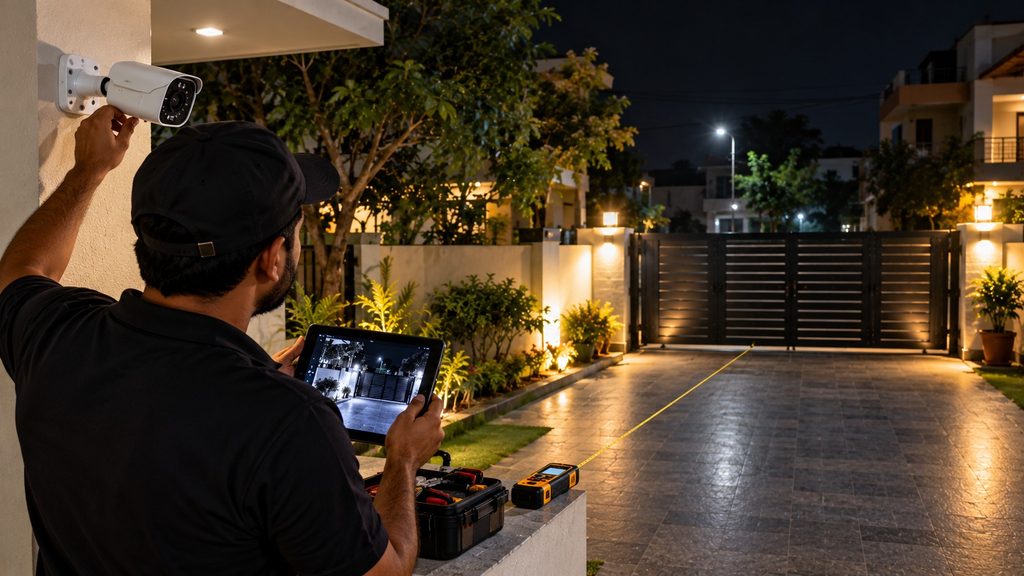
Before You Buy: Use This 60-Second Test
If you’re buying CCTV for your house, shop or office, do this before ordering.
Stand at the location where you expect the person or vehicle to appear.
Check:
Distance: How far away is the subject?
Lighting: What does the area look like after dark?
Angle: Is the camera looking directly toward headlights?
Purpose: Detection or identification?
Colour: Does colour information matter?
Lens: Do you need a wide area or more detail at a specific point?
Storage: How many days of recording do you need?
This simple checklist can prevent a surprisingly expensive mistake.
The Bottom Line
A CCTV camera advertising “30m night vision” isn’t necessarily promising a clear face at 30 metres.
That’s the mistake.
Night vision range tells you about illumination. It does not automatically tell you about identification.
For a good CCTV installation, think about the entire chain:
Sensor + lens + lighting + IR/colour technology + WDR/HDR + camera position + target distance + recording quality.
Get those right and even a reasonably priced camera can produce useful footage.
Get them wrong and a high-megapixel camera can still give you disappointing footage when you need it most.
Frequently Asked Questions
Can CCTV cameras see in complete darkness?
Many conventional IR cameras can produce an image in very dark or completely dark environments by using infrared illumination. However, image detail still depends on the camera, distance, lens, scene and subject.
Is colour night vision better than IR?
Not automatically. Colour night vision can provide useful colour information, but some implementations depend on ambient light or visible illumination. IR can be more practical when the area is completely dark.
Is 30m IR enough for a house?
It can be, depending on the installation. For a normal house, the important question is not simply whether the camera can illuminate 30 metres, but whether it provides the level of detail you need at the actual target distance.
Why does my CCTV become blurry at night?
Possible causes include insufficient light, IR reflection, dirty lenses, incorrect focus, motion blur, compression, poor exposure settings or a camera that isn’t well matched to the scene.
Why does my CCTV show a white face at night?
Strong IR reflection from a nearby person’s face can cause overexposure. Smart IR, better camera placement and appropriate settings can help.
Do I need 4K CCTV for night vision?
Not necessarily. Higher resolution can provide more pixels, but sensor quality, lens selection, lighting and image processing are also important.
Recommended Next Reading
Keep readers moving through the site with related articles such as:
- 2MP vs 4MP vs 5MP CCTV: Which Resolution Should You Actually Buy?
- DVR vs NVR: What’s the Real Difference?
- Why Your CCTV Camera Goes Offline at Night
- How High Should a CCTV Camera Be Installed?
- CCTV Storage Calculator: How Much HDD Do You Really Need?